

Introduction
Nestled in the foothills of the Hajar Mountains, adjacent to the border with Oman, lies Al Ain, the UAE’s second-largest city and its undisputed cultural heartland. A UNESCO World Heritage Site, Al Ain offers a profoundly different experience from the coastal metropolises. Known as the “Garden City” for its vast palm oases, it is a place where the nation’s deep, pre-oil history is palpably present. Al Ain is not just a city; it is the cradle of Emirati civilization, a living museum of ancient sustainability and the birthplace of the nation’s founding father.
The Oasis Ecosystem: A Lesson in Ancient Engineering
At the core of Al Ain’s existence are its sprawling oases, the largest of which is the Al Ain Oasis. This 1,200-hectare UNESCO site is a labyrinth of over 147,000 date palms, crisscrossed by shaded pathways. The lifeblood of this ecosystem is the falaj (plural: aflaj), a 3,000-year-old irrigation system that channels groundwater from the mountains by gravity. Walking through the oasis is a sensory journey into a sustainable past, where the rustle of palm fronds and the gentle flow of water in the falaj channels demonstrate the ingenuity that allowed civilization to flourish in the desert.
Jebel Hafeet and the Bronze Age Legacy
Towering over Al Ain is the majestic Jebel Hafeet, a limestone mountain that is also a prehistoric cemetery. The foothills are dotted with over 500 beehive-shaped tombs from the Hafit period (3200-2600 BCE), marking the dawn of the Bronze Age in the region. Further evidence of advanced civilization is found at the Hili Archaeological Park, which features the remains of a sophisticated Umm an-Nar culture (2600-2000 BCE) settlement, including a grand circular tomb and evidence of early agriculture. These sites confirm that Al Ain has been a center of human settlement and innovation for over five millennia.
The Forts of Power: Al Jahili and the Al Ain Palace Museum
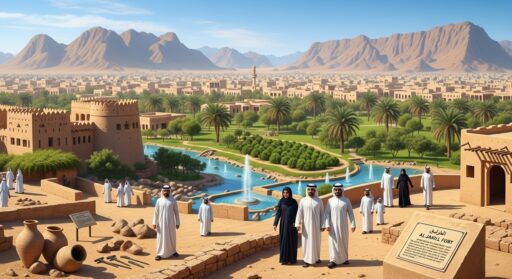
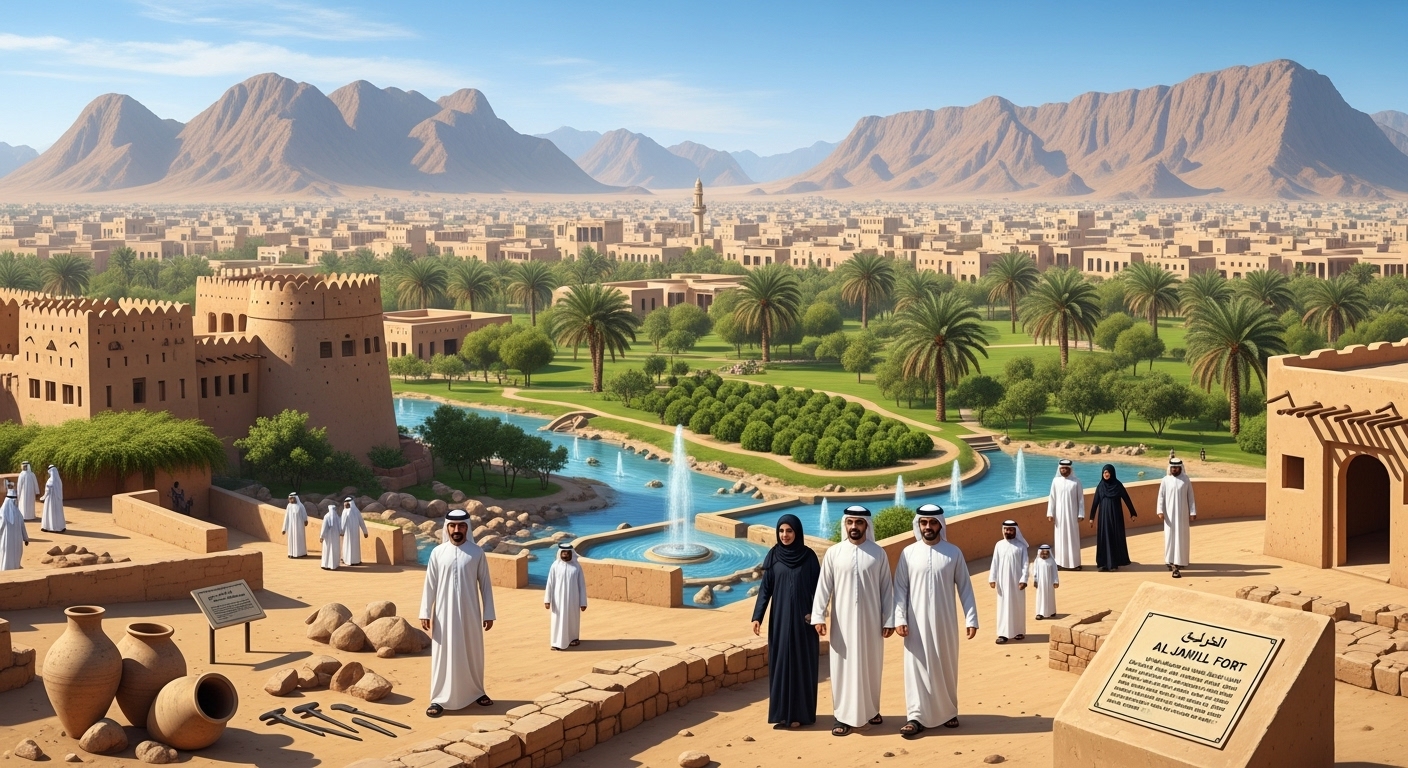
Al Ain’s strategic importance is etched in its fortifications. The magnificent Al Jahili Fort, built in the 1890s, was a symbol of the Al Nahyan family’s authority over the fertile oasis and the trade routes. Its restored walls now house exhibitions, including one dedicated to British explorer Sir Wilfred Thesiger. Nearby, the Al Ain Palace Museum was the former residence of the late Sheikh Zayed bin Sultan Al Nahyan. A visit to this relatively modest palace offers an intimate glimpse into the humble origins of the man who would become the founding father and first President of the UAE.
The Modern Garden City: Sheikh Zayed’s Vision
The title “Garden City” is not merely historical. The late Sheikh Zayed, who served as the Ruler’s Representative in Al Ain before leading the nation, initiated ambitious greening projects here that would later be scaled across the UAE. His love for Al Ain fueled his vision to “make the desert green,” and the city remains a showcase of this philosophy, with its lush public parks, tree-lined streets, and manicured roundabouts. It is a clean, tranquil, and family-oriented city that provides a restorative escape from the bustle of the coast.
Conclusion: The Soul of the UAE
Al Ain is the soul of the UAE. It is where the nation’s deepest history, its sustainable roots, and the personal story of its founding father converge. It provides the essential context for the UAE’s modern story, revealing a civilization of ancient farmers, ingenious engineers, and resilient leaders. A visit to Al Ain is not just a tour of sights; it is a pilgrimage to the source. To understand the UAE, one must understand Al Ain—the eternal oasis, the historical wellspring, and the enduring heart of the nation.